Tag: democracy

  • Reading: The Nerd Reich

    Finished Gil Durán’s The Nerd Reich, which is a history of the last twenty years or so in Silicon Valley, and how the PayPal Mafia and other technologists turned against governments and liberalism.
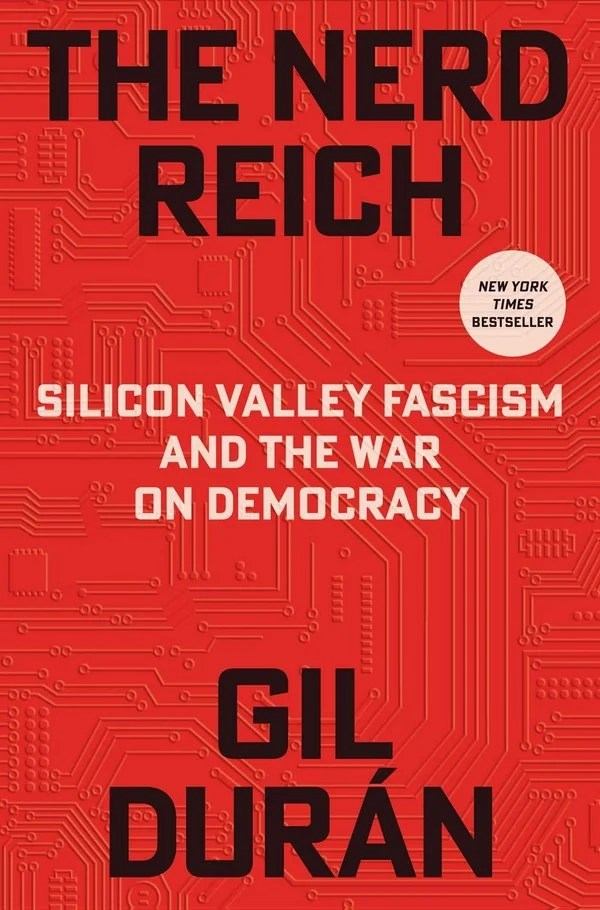
    I am perhaps closer to democratic decay conversations that the average reader, but there wasn’t much in here I didn’t know in one form or another, stitched together into a multi-year story of how Peter Thiel and the people around him reached the positions of wealth and power that they have today.

    The title will tell you this isn’t a fawning biography, Durán – a journalist and political adviser to a number of Democrats – is rightly angry and concerned about what is being done to American democracy.

    However, where the book didn’t land for me is the absence of the rest of the world. Not just in the usual American sense of no other country really being given any attention, but Durán’s hyperfocus on two dozen ultra-rich connected individuals who are driving this movement.

    For a political operative, in particular, it was odd to see nothing – even in the final chapter – that considered why or how these people had built what political following they had; where the fractures might be within the network or – more important – between these billionaires and the wider Trump/MAGA/Techbro movement.

    In particular, the last chapter, looking at the future, seemed to be very light on solutions other than “stop having billionaires”. Where were the mobilisation strategies? What are the political messages that need to be used? How can communities come together?

    A Great Villain theory of history is not so very different from a Great Man theory of history – both over-emphasise the individual, the personal relationships, and the historical destiny of the people involved. Both make contingency and chance seem like divine ordinance.

    If you believe that World Historical Figures exist, perhaps Thiel is one – one for the age of post-democratic technology. What comes across in the book, though, is how far he is from bringing a Fichtian synthesis to contending visions of the world. Rather, he is someone who is driven only by one dark, semi-apocalyptic vision, “made darker still by the lights of a perverted science”, as Churchill said.

    Thiel’s politics and the companies he invested in influence billions of people every day, but those billions of people – at least, those in democratic countries – can push back and cut them down to size. That they have not yet does not mean they cannot, or that they never will.

    Unfortunately the Nerd Reich doesn’t give us many clues on what we need to do to make that happen.

  • Links from the week of 24 October 2022

    Articles, reports and other links I shared on Twitter this week.

  • I wouldn’t necessarily start with LA but I would be fascinated to see this sort of…

    I wouldn’t necessarily start with LA but I would be fascinated to see this sort of experiment actually executed for a fixed 8/10-year period in a reasonably-sized city (“has its own newspaper” size). twitter.com/ArthurSmid/sta…

    This is such a whole-system all-at-once change that you can’t really pilot it without doing it. I personally think it would create more democratic problems that it solves, but I’m very open to being proved wrong. And better to try it at a scale where you can find the problems

    I’m not naïve – I know the logic of political power is that no one will make the sort of self-denying decision that would be needed to make it happen, and even if it failed we would endlessly hear it was because it had not been done right … but still, it *would* be interesting.

    (I am also conscious of the argument that sortition lawmaking is a denial of fundamental human rights as they are defined in some places, ECHR Paris Protocol Art 3 for instance).

  • While I don’t think fair elections can be called undemocratic, it’s clear that the…

    While I don’t think fair elections can be called undemocratic, it’s clear that the Chilean constitutional assembly didn’t work. A sortition-based process + referendum could be a better alternative, with strong anti-gaming and anti-corruption measures. twitter.com/ClaudiaChwalis…

    It would certainly be an interesting facilitation task – though having facilitated a good number of CAs, I suspect you might get the long list of social rights again (though perhaps the process would be less open to attack from the right as being a leftist wish list).

    In general, the big principles are well suited to deliberative exercises if validated by referendum – the fine controversial detail perhaps less so.

  • Negative piece in @ladh on politics of Brussels Parliament’s joint citizen/MP panels -…

    Negative piece in @ladh on politics of Brussels Parliament’s joint citizen/MP panels – headline calls it “Noddy Politics”. Notable for me is how the parties quoted are more critical the further to the political right they are. Eg the right-liberal MR: dhnet.be/regions/bruxel…

    The other notable points (for me) are:
    1. Citizens profited from the experience
    2. Follow up is essential (and seen to be lacking, though that’s hardly the fault of the process)
    3. The link made between citizen assemblies and the intention of abolishing representative democracy

    The last one is a risk for those of us who want to continue experimenting with these approaches without seeing them as an alternative to representation.

  • Regulatory independence (inc on immigration) is the one unqualified benefit of Brexit…

    Regulatory independence (inc on immigration) is the one unqualified benefit of Brexit, bought at a cost in trade, rights and investment. So this might be a good thing. twitter.com/TheScotsman/st…

    The problems are
    (1) does the British state have capacity to make all these judgements consistently better than the better-resourced EU (maybe)
    (2) does the public like the idea of lower regulation on chemicals (doubt it)
    (3) do companies want to have two processes, one for

    the UK market with one range of chemicals and one for the EU market with a different range (almost certainly not, so an EU ban is an effective UK ban, but without a say for the UK.
    I suspect a lot of Brexiteers have in their heads that the UK is just in some hand-wavy way

    better at this than the Europeans, or ready to take a risk that will pay off. There’s certainly not much more democracy in obscure regulatory decisions shifting from Brussels to London.

    So even where Brexit is working as promised, the question is #WasItWorthIt.

  • I’ve said it before but I’m always surprised by how political the King’s speeches are…

    I’ve said it before but I’m always surprised by how political the King’s speeches are, compared to the UK. Today’s (for tomorrow’s fête nationale/nationale feestdag) talks about preventing the growth of inequality, solidarity inside the EU… vrt.be/vrtnws/fr/2022…

    “language that federates rather than divides”, a social model based on inclusion, and the need for an unshakeable commitment to democracy. I agree with a lot of it, so clearly the King is woke, and it isn’t partisan political, but it feels odd from a hereditary office holder.

    Democratic outrage at political influence of hereditary office / pro-solidarity and democracy messages from head of state

    Video on Twitter
  • Links from the week of 13 June 2022

    Articles, reports and other links I shared on Twitter this week.

  • Brits defending the ECHR are in a tough spot.

    Brits defending the ECHR are in a tough spot. A lot of the distinction-drawing between the EU and ECHR feels to me like “if you’re explaining, you’re losing”. People see the CoE and EU institutions as part of a general European setup.

    In most places the distinction doesn’t matter much. It’s only in the UK where the EU has been declared the enemy that it’s important to draw the distinction – but the same spirit of international collaborative rule making runs through both so they *feel* similar.

    This is why pro-HR Brits are in a tough spot and why – as @Samfr said the other day – if the UK Gov wanted to stoop so low as to run a “kick out foreign judges” campaign the field is well set up for them.

    The answer longer-term has to be getting the UK back to its essential identity as part of that European democratic and liberal community – but it’s going to be a hard road, and will need a big culture shift against exceptionalism.

    Until then, it’ll be constant rearguard actions to defend even the most basic of rights for those in the UK. Labour also needs to start laying the groundwork for that culture shift, which it won’t be able do by pretending there’s a “Better Brexit” out there. @labour4europe

  • If Hungary result stays as it is, chances of meaningful reform of EU are strongly down.

    If Hungary result stays as it is, chances of meaningful reform of EU are strongly down. Several more years of Orban and PiS blocking action against each other will use up the Scholz-Macron window of opportunity. After it, Macron can’t run again.

    Might even lead to revival of the small-core Rutte model, either within or outside the current Treaty framework, particularly if HU continues down path of being the Russian asset in Council.

    All in all, it’s extremely depressing. I would say “ah well, that’s democracy”, but given what Fidesz have done to electoral system and media, it’s not that.