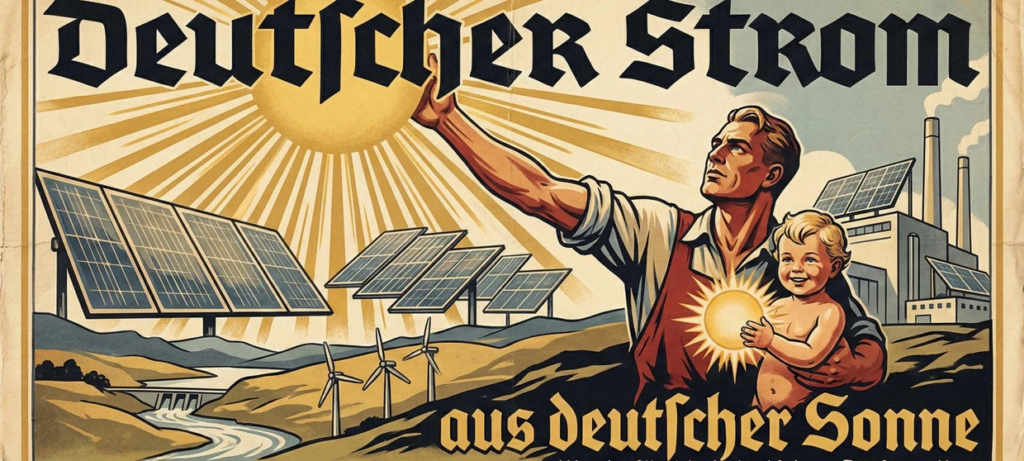
FAZ is reporting on a campaign by the Left party for green energy that uses far-right-themed AI imagery and language to make its case.
Like the example above, slogans include “German energy from German sun”, and “German power from German wind” – but most strikingly, the art work uses a visual language strongly associated with fascism and the 1930s.
The argument that renewables are local and independent is a good one – though of course, “German” energy is as much European energy, given the interconnected nature of the grid.
However, making it in this way is a reminder that we are moving – as Alec Ryrie says – beyond the Hitler age. It’s not enough now to consider fascist language and imagery automatically disqualifying. Fascism is not yet used with pride, but adjacent concepts are, in some quarters.
As someone who grew up with older parents who had direct memory of the war, it is hard to think yourself into this position, but if you imagine something like the Boer War, perhaps you approach it.
Hitler has a resonance in history that Redvers Buller and Henning Pretorius will never have, but still, the issues at stake in the war are fuzzy for most, if they know about it at all. What was so high-stakes five generations ago is now a specialist history subject.
We aren’t there yet with WW2 and Hitler, and maybe it will be another hundred years before we are, but the Left’s campaign idea shows that even for those on the opposite end of the political spectrum, the imaginary language of the far right is a little marketing trick, not a taboo.
It challenges us on the democratic side of the spectrum – what are our images? What is the visual shorthand for democracy, inclusion and rights? We’ve relied for so long on just not being the other side, that we have nothing clear or identifiable to work with. It’s not that “the Left can’t meme”, as FAZ says, but that democracy as a process and set of institutional guarantees is hard to picture.
EU stars, the Portcullis of the UK Parliament, hands raised in voting, ballot boxes, post-it notes on a whiteboard – all of them are process or institutional images, and we need to find a way of showing the impact that they have, and the way they enable people to have a voice.