A brief braindump prompted by hearing talk of an AI minister. Better argued thoughts might follow later.
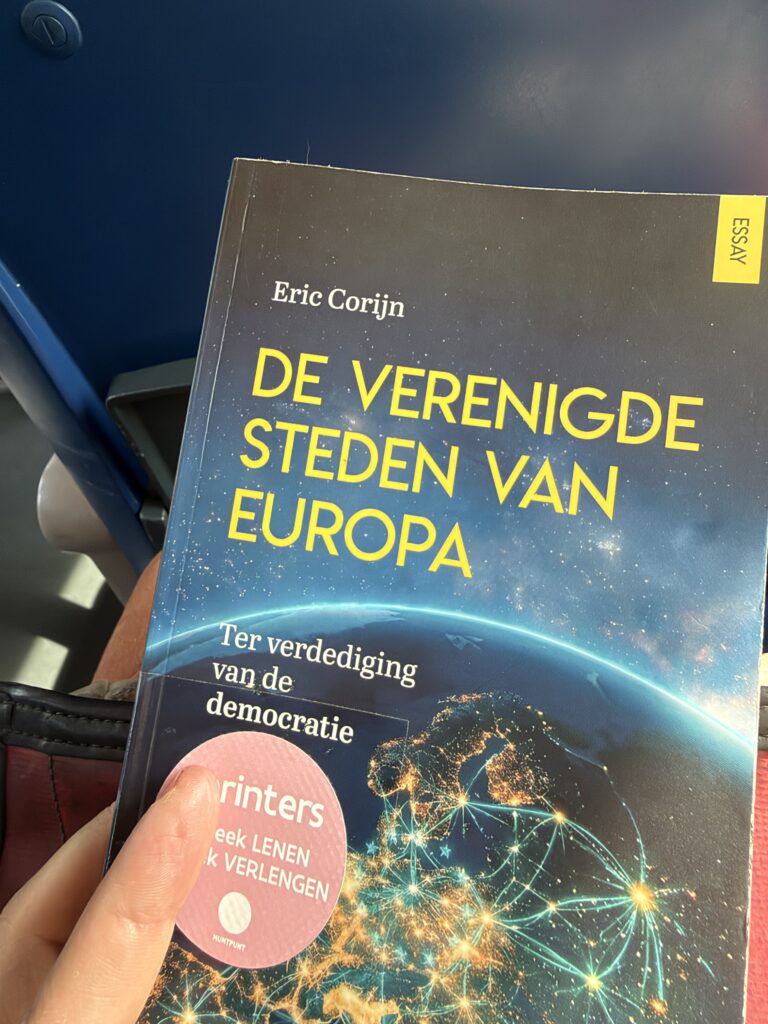
Thinking about “AI ministers” (as in, ministers who are AIs, not ministers for AIs) and citizen assemblies and increasingly convinced that a lot of democracy innovation at the moment is forgetting the perspective of any-given-citizen.
Not the theoretical citizen, averaged out across a thousand assemblies, but without real power in any of them, and with no choice about the issues he or she is asked to deliberate upon.
Not the citizen as policy consumer who can be as well served by a digital minister as by a human one.
But any-given-citizen, a real person who has a certain vision of the world, a certain set of things she or he is annoyed about, and wants to be able to do something – to have some agency.
They have a vote, which we can make more effective. They have a voice, which we can make more powerful. They are a customer of government, which we can make more responsive and more open.
But alongside those already huge challenges, we have to recreate the connection that they used to have through mass parties, unions or churches, from the life that they are living to the decision making level of politics.
I once thought that social media and digital platforms could be that route. I don’t think that any more – or at least, not ones that look like the places where people live online today.
But we need to empower any-given-citizen, not the theoretical citizen. We have to empower them across whatever issues they care about. And when they express themselves we have to have humans listening to humans taking decisions about humans.
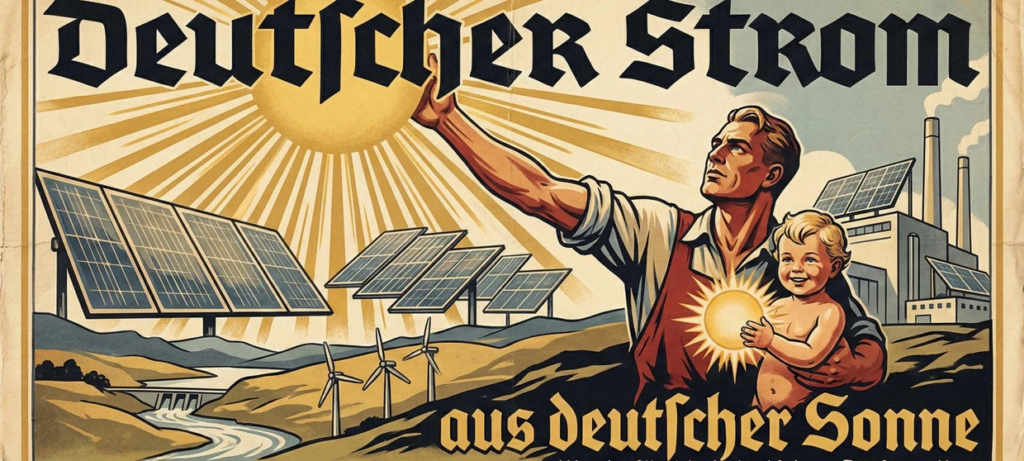
FAZ is reporting on a campaign by the Left party for green energy that uses far-right-themed AI imagery and language to make its case.
Like the example above, slogans include “German energy from German sun”, and “German power from German wind” – but most strikingly, the art work uses a visual language strongly associated with fascism and the 1930s.
The argument that renewables are local and independent is a good one – though of course, “German” energy is as much European energy, given the interconnected nature of the grid.
However, making it in this way is a reminder that we are moving – as Alec Ryrie says – beyond the Hitler age. It’s not enough now to consider fascist language and imagery automatically disqualifying. Fascism is not yet used with pride, but adjacent concepts are, in some quarters.
As someone who grew up with older parents who had direct memory of the war, it is hard to think yourself into this position, but if you imagine something like the Boer War, perhaps you approach it.
Hitler has a resonance in history that Redvers Buller and Henning Pretorius will never have, but still, the issues at stake in the war are fuzzy for most, if they know about it at all. What was so high-stakes five generations ago is now a specialist history subject.
We aren’t there yet with WW2 and Hitler, and maybe it will be another hundred years before we are, but the Left’s campaign idea shows that even for those on the opposite end of the political spectrum, the imaginary language of the far right is a little marketing trick, not a taboo.
It challenges us on the democratic side of the spectrum – what are our images? What is the visual shorthand for democracy, inclusion and rights? We’ve relied for so long on just not being the other side, that we have nothing clear or identifiable to work with. It’s not that “the Left can’t meme”, as FAZ says, but that democracy as a process and set of institutional guarantees is hard to picture.
EU stars, the Portcullis of the UK Parliament, hands raised in voting, ballot boxes, post-it notes on a whiteboard – all of them are process or institutional images, and we need to find a way of showing the impact that they have, and the way they enable people to have a voice.
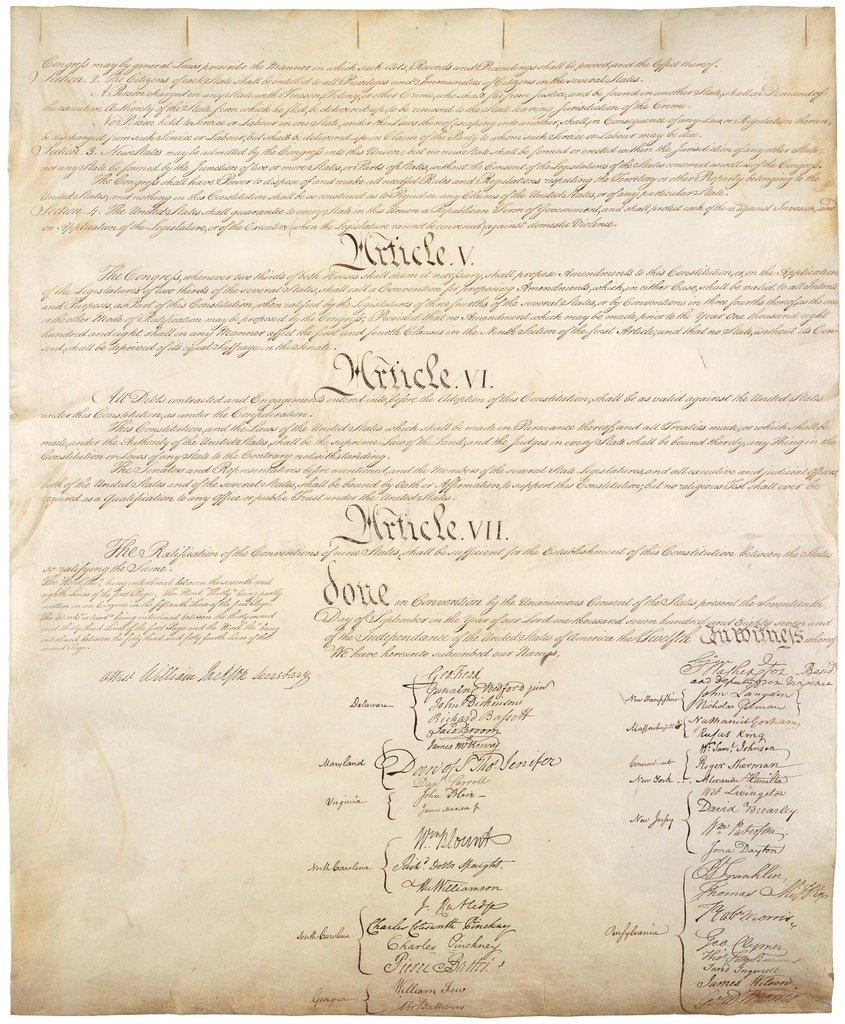
I would love to be corrected on this by someone who understands the US constitution better than I do, but as I read the 25th amendment, it has – with small differences – the same problem as impeachment. There aren’t the votes to make it stick.
Quick summary for those who are less on Bluesky than I am.
The US Constitution allows a President (or any office holder) to be impeached for high crimes and misdemeanours. The House prepares articles of impeachment – the charge sheet, if you like – and the Senate has to vote by a two thirds majority to remove the person from office.
The key point there is the two-thirds majority – sixty-six Senators, in other words, when the current split in the Senate is 53 Republicans, 47 Democrats, and 2 others – both of whom vote with the Democrats most of the time.
Because this bar is high – more than 20% of the elected Republicans would need to switch sides – it is unlikely to succeed, at least until the election in November chooses another House and 33 new Senators to take office in January.
Because of this high bar, a lot of people, not just online politics-heads, have been calling for the 25th amendment to be used. This was brought in for periods of temporary disability (for instance, if the President has had an accident, or is under anaesthetic for an operation).
Section 4 of this amendment allows the President to be temporarily stripped of his powers (while remaining President). However, it’s not as simple as people think, there are two big stumbling blocks.
The first is in the first line of the section:
Whenever the Vice President and a majority of either the principal officers of the executive departments or of such other body as Congress may by law provide, transmit to the President pro tempore of the Senate and the Speaker of the House of Representatives their written declaration that the President is unable to discharge the powers and duties of his office, the Vice President shall immediately assume the powers and duties of the office as Acting President.
It is the Vice President AND, not the Vice President OR – so JD Vance has a veto. Without his consent you can’t use Article 25.
Maybe that’s not too bad – I mean, he’d get to exercise the powers of the President, maybe being dragged for disloyalty on Trump’s Truth Social account would be worth it.
However, the real problem is the second section. If the Vice President has done the dirty (with half the Cabinet) and sent the declaration to the Senate, the President is temporarily powerless. However, in this situation we have to assume that Donald Trump is still there, Truthing away and 100% conscious.
Thereafter, when the President transmits to the President pro tempore of the Senate and the Speaker of the House of Representatives his written declaration that no inability exists, he shall resume the powers and duties of his office
So two minutes after the 25th Amendment is in force, Trump sends a competing declaration to the Senate to say he’s fine, and he takes back his old powers (and presumably fires half his Cabinet).
There is a way around that – the Vice President and a majority of the Cabinet can delay things, but only for four days … and then …
Thereupon Congress shall decide the issue, assembling within forty-eight hours for that purpose if not in session. If the Congress determines by two-thirds vote of both Houses that the President is unable to discharge the powers and duties of his office, the Vice President shall continue to discharge the same as Acting President; otherwise, the President shall resume the powers and duties of his office.
There’s that two-thirds majority again – of both Houses. Not only do you need to get twelve or thirteen Senators to switch sides, you also need to get about seventy Representatives to switch as well.
So the 25th might hold Trump back for a few days – but in the end, he’s back in office and angrier than ever unless you have the same majority you need for impeachment. Impeachment removes him from office completely (though you do then get President Vance).
So – and this is where the Constitution has clearly completely failed – if there is no way to impeach, there is no way to enforce the 25th Amendment.
Brussels is more of a startup city than you might have thought – certainly than I would have thought, even though with Demsoc I have been quite close to it for ten years now (three years at BetaCowork, the rest of the time at BeCentral, both named in the article).
Of course the challenge, like for all of Europe, is why the business that start here don’t grow here.
Josephine Quinn has a new book coming out on civilisation thinking and the “West”. I was already looking forward to it but this article in the FT (no paywall) has made me look forward to it even more.
There aren’t enough cross-language-divide political interviews in Belgian political life, so I enjoyed reading this long one with Jean-Luc Crucke (Les Engagés) in De Morgen.
I did not know that this was in the Marolles … and I guess I can’t be blamed since it closed before the Second World War and since then has been a furniture store. [NL but with photos]
The new exhibition Popcorn at MiMA in Molenbeek is a tonic on a gloomy day. 15 artists, mostly Bruxellois, with paintings and sculptures filled with bright colours and high tones. Open until May and free with a MuseumPass.